
What our housing data tells us about what we don't know
Dr Rob Rowlands, DIN’s researcher in residence

This year, Tom Calver, data editor at The Sunday Times, has delivered two masterclasses for DIN, looking at data on poverty and housing.
While Tom himself would say he's not an expert in housing, I think he underestimates the importance of what he's done.
Through examining publicly available datasets, he's been able to shed light on what we know about these subjects. But perhaps more importantly, he's helped us understand what we don't know.
Take, for example, the most recent session, looking at housing conditions in the UK, which I was lucky enough to host.
Tom took us through a number of available datasets, to help us understand the condition of housing across the country. One of the first things that became apparent was just how limited the information is when we look across all four nations of the UK.
The English data appears to be somewhat more comprehensive than its Welsh, Scottish and Northern Irish counterparts. But even then, it’s far from complete
What lies behind the numbers?
Much of what we know about housing conditions comes from surveys based on samples of properties.
Digging deeper into those surveys, Tom highlighted something particularly interesting: The number of surveys where someone has actually been able to enter a property, inspect it and gather the information needed is diminishing.
Yet at the same time, we're seeing increasing concerns about housing conditions, including the incidence of damp.
So we are relying on datasets that are imperfect, partial and, at times, difficult to interpret. Yet these are the datasets that help shape policy, inform political decisions and influence how people understand the conditions in which tenants and residents live, including the tenants themselves.
That makes them important. And it makes understanding their limitations equally important.
One example Tom highlighted was the apparent difference between national statistics suggesting around 9% of social housing falls below the Decent Homes Standard and figures reported by landlords themselves of around 1%.
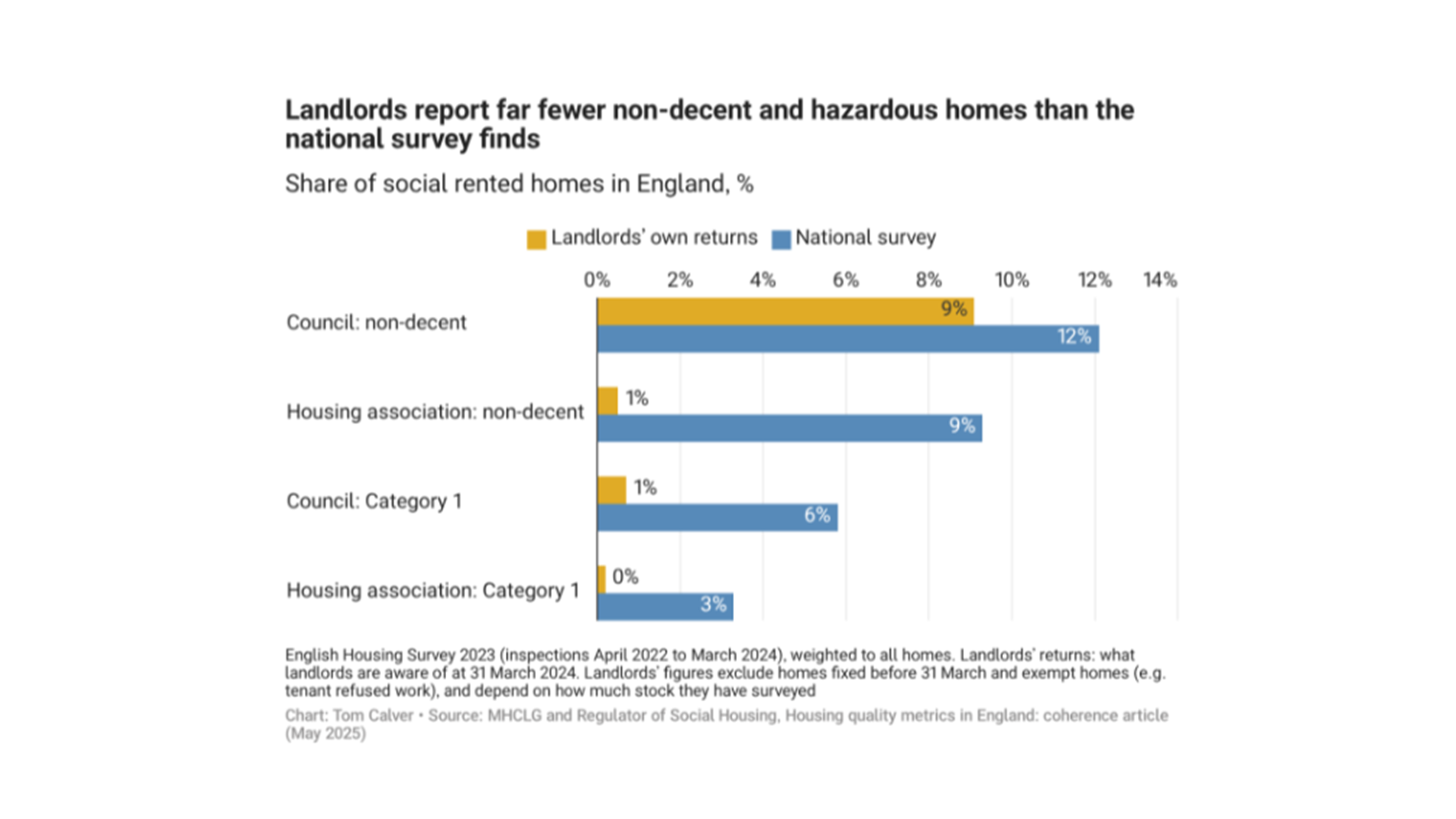
These are two very different figures.
Of course, there may be differences in how the information is collected, what is being measured and how the results are interpreted. We need to understand those before drawing conclusions.
But itdoes raise an interesting question: How well do we really know the condition of the housing we have?
How well do we know our homes?
For individual housing providers, this matters enormously.
Understanding the condition of their properties, how and when they were built, what is already in them and what work might be needed is fundamental to making decisions about investment and maintenance.
And, ideally, being able to anticipate what might be required in the future rather than constantly reacting to changes in standards and legislation. That requires good information. But how confident are we about the information we already hold?
I suspect there are many housing associations that would say their property data is absolutely fine. And perhaps for some it is.
But take time to examine that data more closely, ask what it actually tells you and consider what might be missing, and I wonder how many gaps would start to become apparent.
Discovering what we don't know
This is where I come back to something I've talked about for years.
Research is about filling the gaps in what we don't know. We start by understanding what we already know, identify what's missing and then work out how we can find the information we need.
But what Tom's masterclasses have helped me appreciate is something that takes that thinking a little further.
The process of examining existing data can itself be a way of discovering gaps that we didn't necessarily realise existed.
And that's what I've found so valuable about these sessions.
At first glance, they might appear to be a fairly broad look at subjects that many people working in housing already know something about. Poverty, housing conditions, the statistics that appear in reports and policy discussions.
But look a little more closely at what Tom has been doing, and there's something rather different going on.
He's been questioning the information itself. Looking at where it comes from, what it tells us and where its limitations lie. And in doing so, he's raised questions about how well we understand some of the issues we're trying to address.
For me, that's exactly what DIN should be, and is, doing. Challenging the way we think about familiar problems and encouraging us to look at them differently.
It's easy to become comfortable with the information we use every day, particularly when it appears in familiar reports and dashboards or comes from sources we've relied on for years.
But perhaps we need to spend a little more time questioning what that information actually tells us.
And then what it doesn't.